









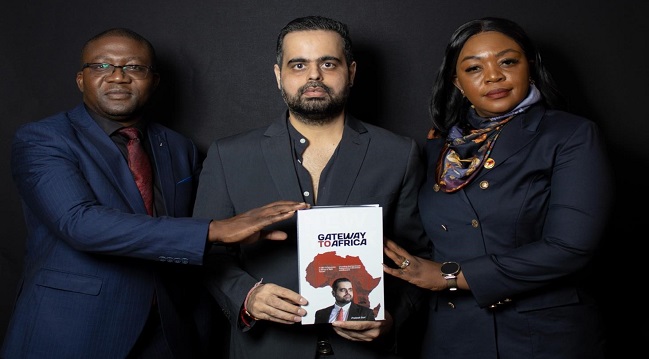
In a private, closed-door session in Dubai, African leaders and one of the continent’s youngest billionaires found common ground in charting the future of Zimbabwe’s economic revival.

Prateek Suri, founder of Maser Group and CEO of MDR Investment, hosted Hon. Nqobizitha Mangaliso Ndhlovu, Zimbabwe’s Minister of Industry and Commerce, and Hon. Tatenda Annastacia Mavetera, Minister of ICT, Postal, and Courier Services, in a wide-ranging discussion centered on Suri’s newly released memoir, “Gateway to Africa”.
The meeting was more than a courtesy call. It was a powerful exchange of ideas—on industrial promotion, exotic startup ecosystems, and critical infrastructure projects—all framed within the blueprint Suri lays out in his book.
Published by Penguin, “Gateway to Africa” has quickly emerged as a manifesto for entrepreneurs and policymakers alike, offering a candid yet strategic perspective on Africa’s position in the new global economy. For the two Zimbabwean ministers, the book provided fresh insights into how frontier economies can adapt bold, unconventional models to unlock industrial growth and digital transformation.
Minister Ndhlovu, responsible for Zimbabwe’s industrialization agenda, found inspiration in Suri’s emphasis on reimagining traditional industries through innovation and sustainability. “The book reinforces our conviction that Zimbabwe can position itself as a manufacturing and trade hub, not by copying existing systems but by building competitive and resilient industries anchored in African realities,” he noted.
Minister Mavetera, a dynamic leader steering Zimbabwe’s ICT sector, echoed that sentiment. She highlighted how “Gateway to Africa” offered pathways for nurturing startup ecosystems that can thrive in environments often perceived as difficult. “Prateek shows us that constraints can be catalysts. His book reminds us that Africa’s digital future will be shaped by our willingness to innovate despite the odds.”
Suri himself was equally impressed by the depth of the conversation. He praised both ministers for their boldness in championing a new narrative for Zimbabwe. “Minister Ndhlovu brings a vision for industrial promotion that is both ambitious and grounded in Zimbabwe’s unique strengths,” Suri said. “And Minister Mavetera’s leadership in ICT is refreshing—she embodies the entrepreneurial spirit needed to leapfrog into the digital economy.”
For Suri, the meeting was not just about sharing his journey; it was also about learning. “What I gained from our dialogue is invaluable,” he reflected. “Zimbabwe is at a critical inflection point, and leaders like Ndhlovu and Mavetera are laying the groundwork for innovation-led growth. Their commitment reinforces my belief that Africa is not just participating in globalization—it is shaping its next chapter.”
The discussions explored potential avenues of collaboration, including industrial projects to enhance Zimbabwe’s competitiveness, startup incubation programs modeled after Dubai’s thriving ecosystem, and critical infrastructure developments that could transform Zimbabwe into a regional economic hub.
What stood out was the ministers’ willingness to integrate lessons from Suri’s memoir into their policymaking. “Gateway to Africa is more than a personal story,” Minister Mavetera remarked. “It is a guide for how Africa can attract capital, nurture talent, and create ecosystems that rival Silicon Valley or Dubai.”
For Africa, and Zimbabwe in particular, the meeting underscored the growing synergy between entrepreneurial vision and political will. Suri’s memoir served as the catalyst for a dialogue that went beyond theory into practical strategies for national renewal.
As the session concluded, Suri reiterated his admiration for the ministers’ leadership. “Zimbabwe is fortunate to have such dedicated champions of progress,” he said. “Their energy and clarity of purpose embody the very spirit I tried to capture in Gateway to Africa.”
The Dubai meeting highlighted not just the power of a book, but the power of ideas when placed in the right rooms. With ministers like Ndhlovu and Mavetera driving innovation and industrial growth, and thought leaders like Prateek Suri providing a global perspective, Zimbabwe’s path to economic reboot looks increasingly promising.
For Africa at large, “Gateway to Africa” is more than a memoir—it is a manual for transformation. And for the global market, it is a reminder that Africa’s leaders and entrepreneurs are no longer waiting for change; they are engineering it.