



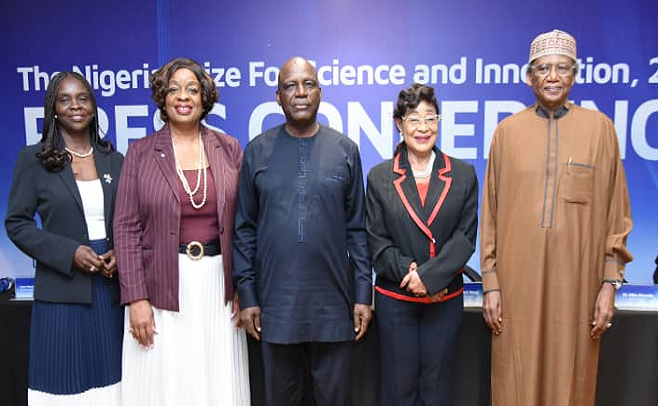

Dr. Bosun Tijani, the minister of communications, innovation and digital economy, has urged African leaders to unite in building shared AI infrastructure or risk marginalisation in the global economy.

Tijani made the call on Monday in Abuja at the inaugural GITEX Nigeria Summit 2025, a four-day technology event focused on advancing digital transformation and innovation with nationwide.
He urged continental collaboration to close Africa’s productivity gap and secure the continent’s place in the emerging AI-driven global economy.
Tijani said Africa faces a clear threat: without intentional action, artificial intelligence could deepen the global productivity divide. In his keynote address, he stated, “If we are not deliberate, AI will widen the global productivity gap. Countries that are already ahead will accelerate further, while those still trying to catch up will fall behind.”
To illustrate this, he referenced agriculture, noting that Nigeria yields about 2.5 tonnes of maize per hectare, compared to 6 tonnes in South Africa and 12 tonnes in Brazil.
The difference, he explained, is not due to land or rainfall, but to productivity gains driven by technology and AI-powered precision farming.
Tijani identified four key pillars to guide Africa’s approach to AI: balancing national sovereignty with shared governance, equipping young people with technical skills, digitizing local realities to develop relevant datasets, and making joint investments in infrastructure — including internet connectivity, computing capacity, and clean energy.
He highlighted the importance of Africa’s youth, calling them the continent’s greatest asset. As an example, he pointed to Nigeria’s 3 Million Technical Talent (3MTT) program, which aims to build a workforce prepared for the demands of an AI-driven economy.
The minister emphasized that without digitizing African datasets related to language, health, and agriculture, the continent will continue to rely on foreign AI models built from data that “do not represent us.”
Following the sessions in Abuja, the event will move to Lagos for the Tech Expo & Future Economy Conference, scheduled for September 3-4 at the Eko Hotel Convention Centre. A Startup Festival will also take place at the Landmark Centre.
On infrastructure, Tijani stressed that no single country can bear the financial burden alone.
He explained, “AI relies on three essentials: connectivity, computing power, and clean energy. These resources remain costly and unevenly distributed across Africa. We must work together on medium- and long-term strategies to reduce costs and enable inclusive participation.”
He added with an inspiring message, “Our children should one day look back and say: our leaders prepared us, our leaders secured our future, and our leaders made sure Africa was not left behind.”
Trixie LohMirmand, the executive vice president of Dubai World Trade Centre and CEO of KAOUN International, highlighted the importance of global cooperation in advancing Africa’s digital economy.
She noted that partnerships between Nigeria and international stakeholders can foster innovation, attract investment, and position Africa as a leader in the global tech arena.
Also speaking, Kashifu Inuwa, Director General of NITDA, opened GITEX Nigeria 2025 with a welcome address emphasizing the need for continental unity in Africa’s AI development.
He stressed the importance of building shared infrastructure, developing algorithms rooted in African values, and establishing strong policies to ensure the continent takes an active role in the AI revolution.
Nigeria has emerged as a leader in AI innovation on the continent. Ranked among the world’s top 60 countries in AI development, Nigeria recently unveiled a National Artificial Intelligence Strategy created through collaboration between academia and industry.
To advance this strategy, the government launched the Nigerian Artificial Intelligence Collective Industry, aimed at connecting local researchers with international experts and fostering cross-border cooperation.
The four-day event, held from September 1 to 4 in Abuja and Lagos, is supported by the Ministry of Communications, Innovation and Digital Economy alongside the National Information Technology Development Agency.